
.png)

Grok's sexist prompt

.png)
by Rosie Audino, expert in philosophy and science and health communication
In recent months, there has been discussion about the case of Grok, a generative artificial intelligence chatbot developed by Elon Musk's company xAI, integrated directly into the X platform (formerly Twitter), which was accused of generating sexualized images of thousands of female bodies without their consent. What happened with Grok is not an isolated incident, nor is it the only way gender-based violence manifests online. On this topic, I recommend reading the book The Internet is Not a Place for Girls by Silvia Semenzin, sociologist, researcher, and digital rights activist. In this brief but comprehensive account of online gender-based violence, Semenzin explains that as early as the 1990s, this space began to be used as a tool for controlling female bodies. It was precisely in those years that the precursors to today's online groups emerged, where sexualized images of female bodies were disseminated without consent. This is a concrete early example of control, as women are deprived of the freedom to decide when, to whom, and how to display and represent their own bodies. Over time, the online space, initially conceived as neutral, transformed into an environment that conditions and limits female autonomy.
Discussing "a tool of control" means recognizing that it's not just about isolated incidents of violence, but a broader system that influences what is visible and what is hidden. On one hand, content related to sexual freedom and self-determination, such as that produced by sex workers or sexual educators, is penalized or made invisible. On the other hand, algorithms tend to prioritize images of female bodies that conform to sexualized stereotypes and are more likely to go viral. The result is that some forms of expression are silenced while others are amplified, thus shaping perceptions and behaviors.
In this way, free and self-determined sexuality is marginalized, while a representation of the female body as an object of consumption for the heterosexual male gaze is favored. Added to this is a business logic, as such content generates engagement and thus profit. Monetization further reinforces this mechanism, rewarding what is most marketable and making it even harder to escape these dynamics of control.
But let's take a step back.
Cyberfeminism and Early Digital Communities
The 1980s saw the emergence of the cyberfeminist movement, which viewed digital technology, and the internet in particular, as a tool to overcome gender hierarchies. In early virtual communities, users could experiment with different aspects of their identity and subvert sexual roles through practices like gender swapping. Later, with the launch of the World Wide Web, many LGBTQIA+ individuals living in repressive contexts found a safe and anonymous space online to express their identity. Chatrooms, forums, and discussion groups allowed them to connect with others who had similar experiences, overcoming geographical and social barriers and finding support during a period when cultural taboos and laws hindered sexual freedom. Historical examples include SAPPHO, the first American lesbian mailing list born thanks to USENET, and groups like SOC and MOTSS (Society of Members of the Same Sex), which offered online spaces during the AIDS crisis and the stigmatization of the LGBTQ+ community.
The Economy of Desire and the Sexualization of Bodies
It soon became clear that these "happy islands" were not immune to market forces. In the 1990s, with the early developments of the web, it became evident that digital technologies could capitalize on erotic desire, transforming it into revenue streams through advertising and subscriptions. A case in point is Minitel, which started as a telematics service platform and found success when it began offering erotic chats and interactive sexual content. Examples like this show that sex became a structural component of the web's economic development, inevitably reproducing power hierarchies that favored male actors.
In this context, the first forms of online violence emerged. An early example is the page Babes on the Web from 1995, which non-consensually collected photos and personal contact information of female communication professionals, subjecting them to appearance-based voting and sexually explicit propositions from users. This model foreshadowed today's groups dedicated to the non-consensual dissemination of intimate images, such as those found on Telegram.
Deepfakes, Deepnudes, and Grok
Today, online gender-based violence proliferates through social networks, virtual realities, and artificial intelligence. Pornographic deepfakes are AI-generated images or videos that insert a real person's face or body into sexual content without their consent. A subcategory is deepnudes, tools that digitally simulate a person's nudity from clothed photographs.
In 2023, the spread of deepnudes increased by 500%, and today sexual content accounts for approximately 94% of online deepfakes, with 99% of victims being women (Home Security Heroes, 2023 - State Of Deepfakes: Realities, Threats, And Impact). These AIs work better on female bodies because they are trained on predominantly female datasets, often proving incapable of reconstructing male bodies. For this reason, they are defined as "misogynistic by design," engineered to transform the female body into male entertainment. In 2025, tools linked to Grok were accused of producing erotic deepfakes of celebrities, including Taylor Swift.
But the story doesn't end there.
“Put Her in a Bikini”
An investigation published in January 2026 by The Guardian revealed how a simple prompt, “put her in a bikini,” became one of the most viral trends related to AI use on the X platform within a few weeks, transforming the Grok chatbot's image generation tool into a machine for producing large-scale sexualized images. The mechanism was extremely simple: users just had to post or quote a photograph of a real person and tag Grok with a text request, often precisely the phrase “put her in a bikini.” In a few seconds, the AI generated a new version of the image, digitally altering the clothing of the person depicted and transforming an ordinary photo into a sexualized representation.
According to an analysis by the Center for Countering Digital Hate, in just eleven days the tool produced approximately 3 million sexualized images, at an estimated rate of about 190 images per minute. The prompt “put her in a bikini” quickly became a genuine platform meme: thousands of users repeated it under photographs of women taken from social networks, public accounts, or images circulated online, asking the AI to modify the appearance of the people depicted. Apparently born as a simple aesthetic modification, the trend soon transformed into a widespread practice of non-consensual 'nudification' and sexualization of images.
The investigation highlighted that the vast majority of generated images depicted female bodies. Of the millions of analyzed contents, approximately 2 million depicted women, while about 23,000 appeared to represent minors, a figure that raised alarm among researchers and organizations monitoring digital abuse. The system's very operation contributed to the phenomenon's spread: generated images could be published directly in platform threads and reshared by other users, allowing content to circulate rapidly and amplifying the trend's visibility (The Guardian, 2026)
The sexist algorithm
As researcher Simona Semenzin explains in her book, images circulating on social networks are not neutral: they are constantly analyzed and filtered by algorithms designed to “manage” what is shown to the public. In theory, the stated goal is to protect users, but in practice, these systems decide which voices are amplified and which are silenced, transforming platforms into true arbiters of visibility. Bodies perceived as female, always sexualized and subject to cultural norms of desirability, undergo ambivalent treatment: they are penalized when expressing autonomy or free sexuality, but are valued when embodying dominant stereotypes intended for male pleasure.
Shadowbanning: in the shadow of the latest feed
Those who work with their bodies—performers, sex workers, sexuality educators, actresses, photographers—experience this mechanism daily. Words like “OnlyFans,” “escort,” or “sex work” are often automatically flagged by algorithms and deleted, even when used in educational or human rights contexts (Global Network of Sex Work Projects, 2025).
But that's not all; hidden profiles, shadowbanning, and reduced visibility without users being informed are common experiences for certain categories of creators. The phenomenon is not marginal: according to the 2025 report by CensHERship and The Case for Her, 95% of female health content creators have experienced forms of censorship or restrictions on platforms like Instagram, TikTok, Facebook, X, YouTube, and Pinterest (CensHERship, Censorship Revealed, June 2025) . These include queer or sex-positive accounts, but also accounts that address topics of freedom, reproductive rights, and health, such as abortion. . It happened to Hey Jane, a telemedicine clinic providing abortion pills, emergency contraception, and health information, found their profile difficult to locate in searches. A post by Hey Jane titled "5 Facts About Abortion You Need to Know in 2025" was removed because the algorithm deemed it to violate rules on drug sales, despite the organization being certified by LegitScript, an online pharmacy verification body (The Guardian, 2025).
That time Geen.ai...
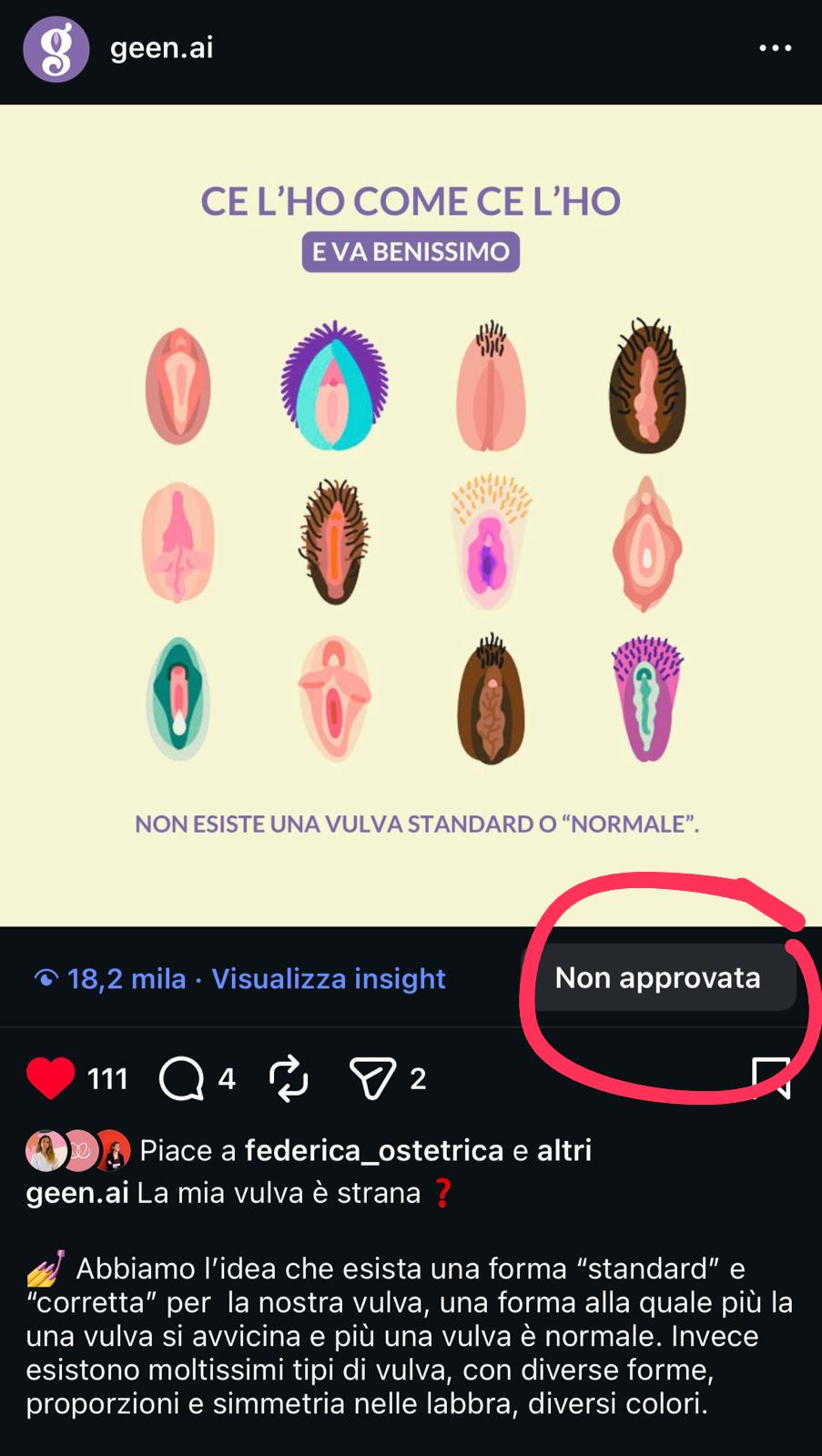
We at Geen.ai have also experienced content limitations related to sexual and reproductive health. Ours is one of the European case studies included in the CensHership White Paper, a report that collects data and evidence to document the systemic censorship or limitation of online content on women's health and promote more transparent regulation.
Geen.ai was also the only Italian startup to contribute to this initiative at a European level, by signing an open letter promoted by CensHership and formally submitted in early 2025 as a complaint under the European Union's Digital Services Act, for which we are still awaiting a response.
The complaint was also examined by AGCOM which, after an initial assessment, forwarded it in February 2026 to the competent Irish authority, responsible for META, which has initiated case evaluation activities.
The image shows one of Geen's posts that was censored: as you can see, it's purely informative content, nothing offensive (all details are on page 20 of the downloadable CensHership report)
At the same time, sexist or violent content, from non-consensual deepfakes to sexualized images disseminated without consent, is often amplified by the same algorithms. Just think how quickly images depicting female bodies go viral, especially when they involve well-known online figures, often with severe consequences and causing significant distress to the victims (recently, Elisabeth of Belgium was also a victim of sexual deepfakes). This happens because systems reward what generates strong or polarizing reactions: greater engagement, dwell time, shares, and interactions directly translate into more monetization. Thus, the female body objectified for male pleasure becomes visible and replicable on a large scale, while self-determined and conscious sexuality is obscured or censored. And so, the cyberfeminist dream of online spaces as sites of resistance risks transforming into places where power dynamics that privilege the male gaze are not only replicated but also amplified.
In this scenario, technology is not neutral: it reflects the choices of those who design it. For this very reason, it can become part of the problem, but also part of the solution. If developed responsibly, it can help reduce inequalities instead of amplifying them.
At Geen.ai, we are working in this direction: we have developed a platform that uses artificial intelligence to make healthcare services more accessible, improve the match between needs and expertise, and support more informed decisions. At its core is a human-centered approach and "inclusion-by-design" AI, which integrates disaggregated data, clinical knowledge, and continuous evaluation systems.
The goal is clear: to use technology to bridge existing gaps, not to automate them, and to help build a more equitable, transparent, and inclusive digital and healthcare ecosystem.


.png)
.png)