
.png)

Why we built Geen?

Every year, people and organizations face avoidable costs caused by limited accessibility, fragmented information, and poor integration between healthcare demand and service availability. People struggle to identify the right professionals for their needs, while public institutions and companies lack effective tools to monitor, optimize, and personalize care pathways and interventions.
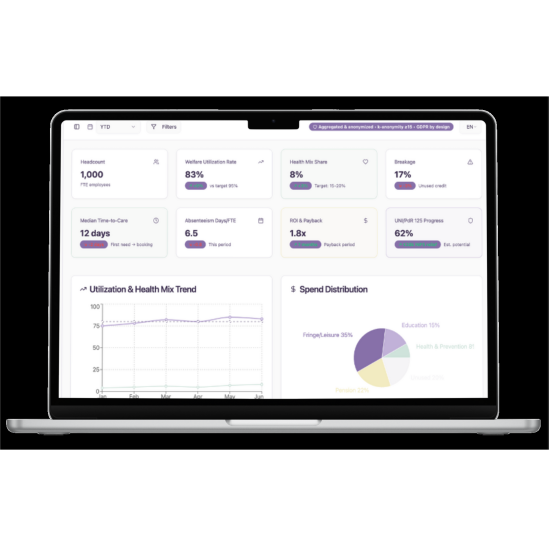
Geen was built to address this structural inefficiency: a digital platform that combines artificial intelligence, triage systems, and a proprietary data hub to connect healthcare needs with the right professional expertise. The result is better decision quality, reduced access times and costs, and objective insights to support healthcare planning and employee benefits strategies.
Human-centered data
Closing data gaps to build more equitable healthcare systems.
We believe data is the foundation of more equitable healthcare systems. That’s why we design our infrastructure around a human-centered data architecture, where information can be disaggregated by sex and gender, age, socioeconomic context, ethnicity, and geography, and connected to clinical guidelines, care pathways, and real-world services.
Through knowledge graphs and clinical taxonomies, Geen prevents differences from being flattened into anonymous averages — addressing the gender data gap and other structural gaps in healthcare data. We also explore these topics on our blog.

Trustworthy AI
Driving innovation that includes, not excludes
Geen's AI is designed with an "inclusion-by-design" approach: it doesn't start from a generic and neutral model, but from a GraphRAG-based triage engine that combines LLMs, knowledge graphs, and verifiable clinical rules. We work on three technical levels: data quality, model architecture (triage, routing, ranking), and continuous evaluation tools (audit trail, group-based slicing, appropriateness metrics). The goal is to use AI to expand access and reduce inequalities, not to automate them.