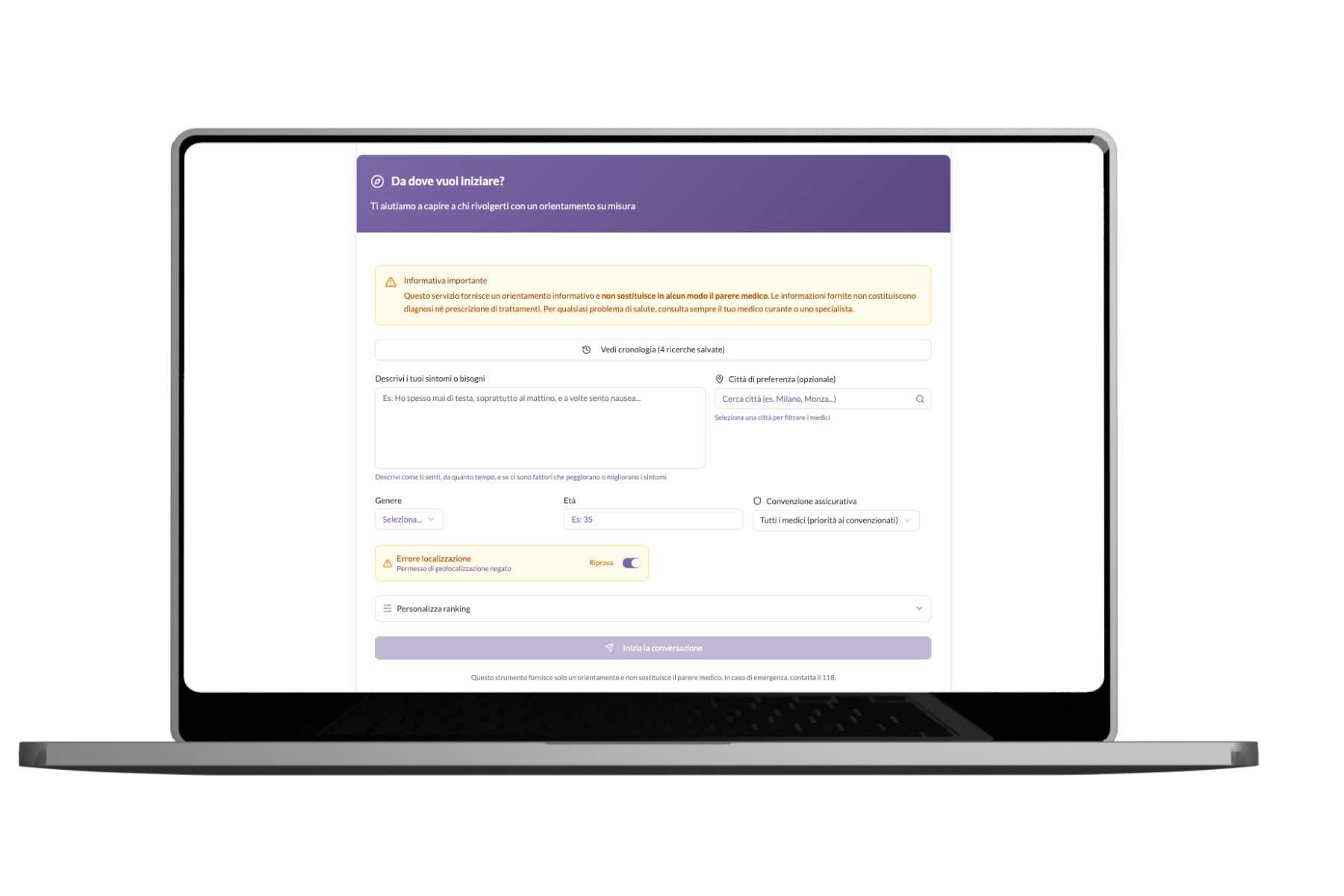
Geen AI interprets health and care requests and directs every need to the most appropriate service.
For organizations, that means more accessible services, more appropriate care pathways and less avoidable cost.
Designed to the highest standards of security and reliability · GDPR by design · ISO 9001 · ISO 27001 · UNI/PdR 125 · EU hosting
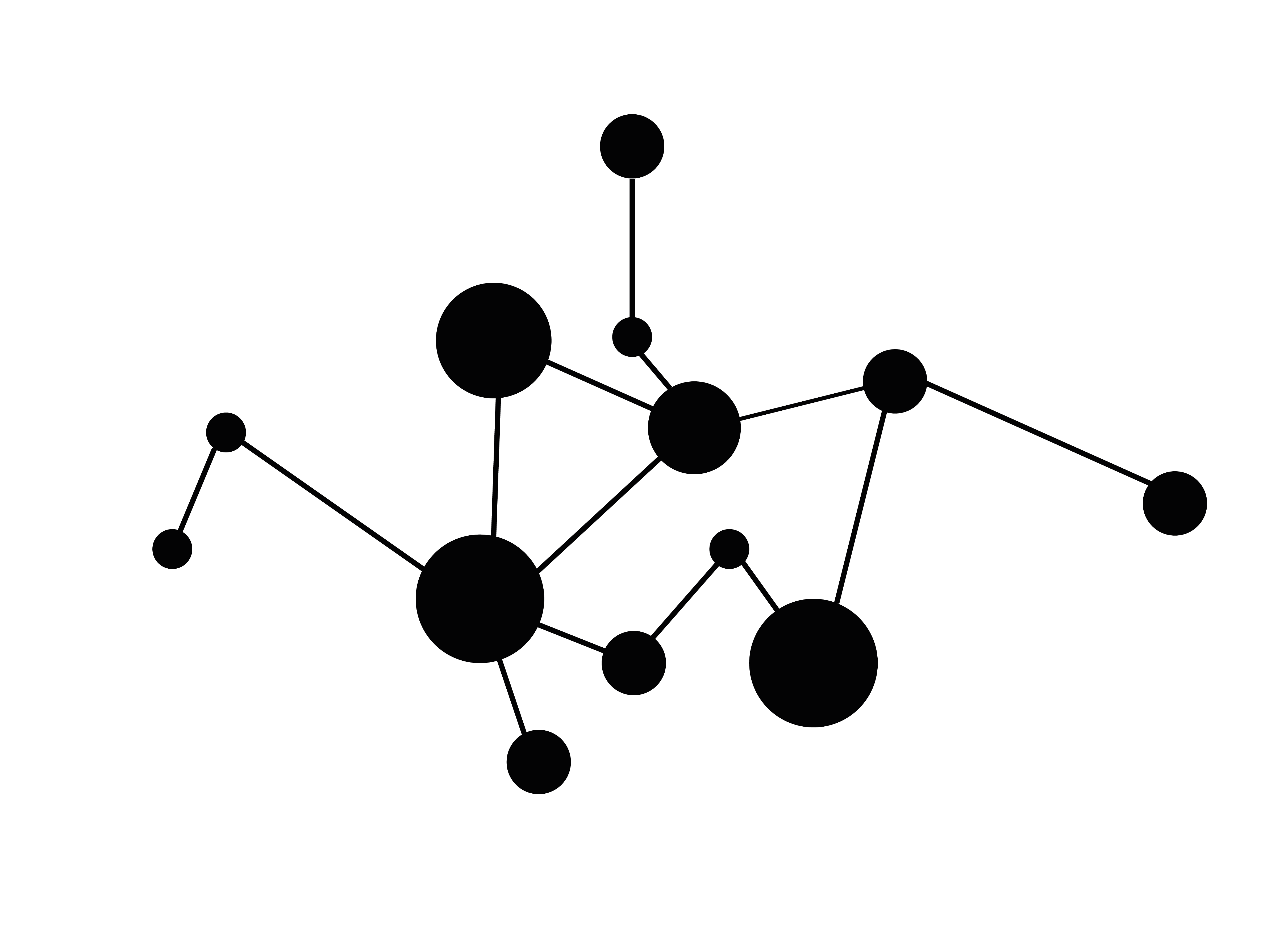
Geen AI builds a network of relationships between needs, services, care pathways and rules, making the complexity of your organization navigable. The solution is modular: it starts from the use case you need and grows with the complexity of your network.
Citizens and healthcare and social care staff describe what they need in their own words.
The language model extracts needs, symptoms, risk factors and gender differences, and maps them to official clinical classifications.
It routes the request through the knowledge graph, where care pathways (PDTA), guidelines and your network's services are linked, and identifies the possible pathways.
It evaluates the possible pathways against criteria configured for your organization and recommends the most appropriate one, with the sources that support it.
Three ways to embed it in your workflow

Each organization configures the engine around its own network, regulatory context and objectives.
Your organization knows the cost of **inappropriate use of services** all too well: staff tied up with requests that are not theirs to handle, **waiting lists that grow longer** for those who truly need care. Geen AI builds every pathway on the **real regulatory and regional context**, care pathways (PDTA), home care (ADI), Community Health Centres (Case della Comunità), so demand is managed **before it ever reaches the front desk**. The result is **healthcare capacity that frees itself up**, with no need to hire or cut.
People who turn to your municipality often don't know whether their need is health-related, social or both, and end up **bouncing between different offices** before finding the right answer. Geen AI brings social services, the Third Sector and local support networks together in **one point of access**, able to guide the person **at the first contact rather than the third attempt**. It is already a reality with **IncludiME**, the project built together with the Municipality of Messina.
Discover IncludiME →Every member who ends up on the wrong pathway is a **cost that weighs on your loss ratio**, even before it weighs on their time. Geen AI builds **coverage and the contracted network** directly into the pathway calculation, so guiding members to the right providers becomes **part of the insurance product**, not a problem to manage downstream. **Fewer out-of-network services**, fewer pathways to correct, firmer control over healthcare spending across your base of policyholders.
Every wrong booking on your platform is a user who goes elsewhere, or who comes back asking for help instead of completing the purchase. Geen AI routes every request to the **right specialist from the first contact**, with the network of professionals and services already integrated into the graph, **increasing conversion** and reducing post-booking support requests. The engine has already been validated end to end on **Chiedi a Geen**, the vertical application for sexual and reproductive health.
Try Chiedi a Geen →And for people? More precise guidance improves the quality of health choices: less time lost, fewer false starts, more appropriate care pathways.
Already in action
The first AI equal-opportunities desk of an Italian municipality.
An online platform offering personalized information and referral to specialists in sexual and reproductive health.
Fragmented services, different pathways in every region, ever-changing guidelines: finding the way is complex, even for those who work in the system.
of service use is inappropriate
AGENAS, 2023
estimated annual waste
Geen AI study, 2026
of insurance spending comes from inefficient guidance
Geen AI study, 2026
The cost isn't in the services that are missing. It's in the requests that reach the wrong service.
We can analyze where inappropriate requests and pathways concentrate and identify the main areas of waste.
Request a free efficiency check →A first conversation about your context, no commitment.
A generic model produces the most probable answer. Geen AI builds every answer on a verified knowledge base made of official clinical sources.
Geen AI combines a knowledge graph with verified clinical sources to turn a request expressed in natural language into appropriate, verifiable guidance.
The engine retrieves and weighs evidence on the clinical graph before generating a response. Above a calibrated confidence threshold the graph determines the specialty; below it, the language model proposes one, informed by the graph evidence, and the answer is flagged as not verified. Pathways, services and professionals always come from the graph.
Evidence is weighted against defined, calibrated criteria. The output makes explicit how well a recommendation is supported by the available information.
The model operates within a perimeter defined by the graph and the system's rules. It only suggests destinations supported by the knowledge base.
What keeps it alive
When a more recent act is issued, it automatically replaces the previous one.
A PubMed pipeline continuously ingests new publications, specialty by specialty.
Official registries added region by region, with deduplication and review before activation.
Two coding layers, kept distinct and linked: the Italian one (ICD-9-CM, ICD-10-IM and CIPI, mandatory from 1 January 2027, with over 30,000 official crosswalks) and the international one (WHO ICD-10, ICPC-2, OMOP vocabularies), each with source, version and mapping method.
Standards and ontologies, by level
A vocabulary, or classification, lists and codes concepts; an ontology defines the relationships between concepts. Geen AI uses open standard vocabularies and its own navigation ontology, which links need, pathway, specialty, service and professional, documented and under version control.
ICPC-2 (International Classification of Primary Care, WONCA) as the body-system axis and, through chapter Z, for social problems; the WHO ICD-10 (International Classification of Diseases); OMOP (Observational Medical Outcomes Partnership) vocabularies for crosswalks; HL7 FHIR R4 (Fast Healthcare Interoperability Resources) for interoperability; the Gravity Project for social determinants of health. SNOMED CT only in research and development, under a dedicated licence, never in routing.
ICD-9-CM, the Italian National Health Service standard for data flows and exemptions; ICD-10-IM (Italian Modification) and CIPI (Italian Classification of Procedures and Interventions), introduced by the Ministerial Decree of 23 October 2025; the national nomenclature of specialist services (Ministerial Decree of 25 November 2024) and the 51 ministerial disciplines; AGENAS referral-priority criteria (RAO); for social care, the CISIS nomenclature of social interventions and services, LEPS (essential levels of social services) and RUNTS (the national third-sector registry); FSE 2.0 (the national electronic health record) and PDND (the national data interoperability platform) for interoperability.
Care pathways (PDTA) and guidelines from 20 regions and 2 autonomous provinces, regional registers, local health authority directives, each client's own networks and catalogues. An explicit hierarchy sets which rule applies to each person: client, local health authority, region, national, international, in that order.
The navigation ontology is proprietary and links need, pathway, step, specialty, facility and professional. The social-needs ontology, 12 areas in 4 domains, is derived from public standards, the ISTAT user areas and the CISIS nomenclature, and carries for each area the ICPC-2 Z, ICD-10 Z55–Z65, LEPS, HL7 and Gravity Project codes.
Nothing enters the graph without human review and traced provenance.
Geen AI doesn't just return a recommendation: it shows the elements behind it, making the pathway understandable and verifiable.
“It might be helpful to see a cardiologist for this type of symptom.”
No verified source
No traceable pathway
No structured link to the service network
“Cardiology — score 0.91. Referral to this specialty, with suggested pathway and providers.”
Verified clinical sources
Structured knowledge graph
Traceable chain of evidence
Geen AI is designed to fit into healthcare and organizational settings where data, security and traceability cannot be added after the fact.
Geen AI operates within the scope of healthcare navigation: it identifies the most appropriate pathway and service without replacing the assessment of the healthcare professional.
Widget, dedicated page or API call — no migration, no changes to the customer's infrastructure.
No user identifiers are visible on Geen AI's side, by architectural design. No data transfers outside the EU.
Certifications for information security, process quality and gender equality, verifiable on request.


SanitàNo commitment, and no access to your systems required for the demo. We show you the engine on real cases from your field: clinical, social care or insurance.
We answer any technical or compliance question.
Prefer to write to us directly? info@geenapp.it