.png)

What do knees have to do with gender equality?

by Rosie Audino, expert in philosophy and science and health communication
The Milan Cortina 2026 Winter Olympics set a record with 47% female participation… yet female athletes' bodies are still less considered than those of male athletes.
This is the highest female participation in the Olympics in history, but it wasn't always this way.
The Olympic Games, born in 776 BC in ancient Greece, remained an exclusively male affair for centuries. Women only entered the Summer Olympics in 1900, and in the first Winter Olympics in Chamonix in 1924, they were confined to a single discipline.
In 1924, in Chamonix, the only discipline open to women was figure skating. This wasn't because it was less demanding than others, but because at the time it was considered particularly suitable for highlighting qualities like grace, balance, and agility, rather than physical strength, in line with traditional ideals of femininity. But don't think they had an easy time in this category.
A white lie: how women challenged figure skating rules
In 1902, Madge Syers was the first woman to participate in the World Figure Skating Championships, but she did so thanks to a genuine loophole. At the time, there were no rules prohibiting female participation: regulations did not specify the sex or gender of competitors, which wasn't necessary since women didn't enter competitions. So Syers entered the World Championships held in London in the men's category and placed second, losing only to Salchow. The latter, impressed by her performance, even offered her his gold medal, convinced she was the true winner. After that event, the World Figure Skating Championships (WFSC) decided to ban women's participation. The official reason? The long skirts competitors had to wear (short skirts or trousers were not allowed) prevented judges from properly observing their feet during performances. But all was not lost.
Thanks to that challenge, in 1908, the women's figure skating championship was finally established, paving the way for its Olympic debut in 1924.
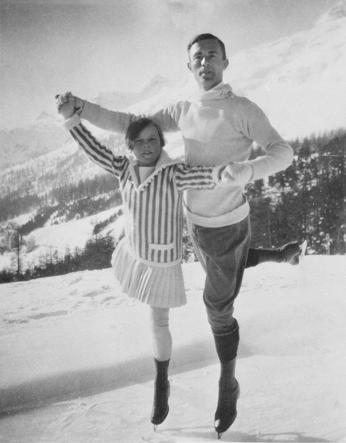
The first Winter Olympics in figure skating was won by Herma Szabo, but from that competition, a true star of the discipline emerged: Sonja Henie. Despite not coming from a family of athletes, she amassed extraordinary successes. At just fifteen, she won her first world gold, followed by nine more consecutive titles between 1927 and 1936. She is among the very few in the world to win three consecutive Olympic golds in 1928, 1932, and 1936. An absolute record! It was Henie, very young, only eleven years old, who was allowed to wear a short skirt above the knee; the choice was made precisely because she was a child and not because it was a technical exception. From that moment, all other female skaters began to imitate her, and this style became the norm until 2004, when female skaters gained the option to also wear trousers or jumpsuits in single and pair competitions.
From the first Winter Olympics to Milan-Cortina: a long-fought achievement
Over time, women have come to compete in all disciplines—alpine skiing, cross-country skiing, ice hockey, and snowboarding—though initially in still small percentages. At St. Moritz 1948, they represented only 11.5% of athletes, while at Cortina 1956, they rose to 16%. Today, however, the context is completely different: at the Milan-Cortina 2026 Olympics, approximately 47% of the spots will be reserved for female athletes, with over 1,360 women out of 2,900 participants and 50 women's events out of 116 total. A true record!
Knees and gender equality: the road is still long
But what do knees have to do with gender equality? Well, actually, much more than it might seem. Consider Sonja Henie, who introduced shorter skirts in figure skating, finally bringing a freedom of movement that was previously impossible. In the costumes of the time, women were forced to wear long, heavy skirts, which restricted movement and made performances more difficult. Thanks to her stylistic choice, Henie not only modernized the sport's aesthetic but also concretely helped improve competition conditions for female skaters. But there's another issue related to knees that continues to hinder gender equality.
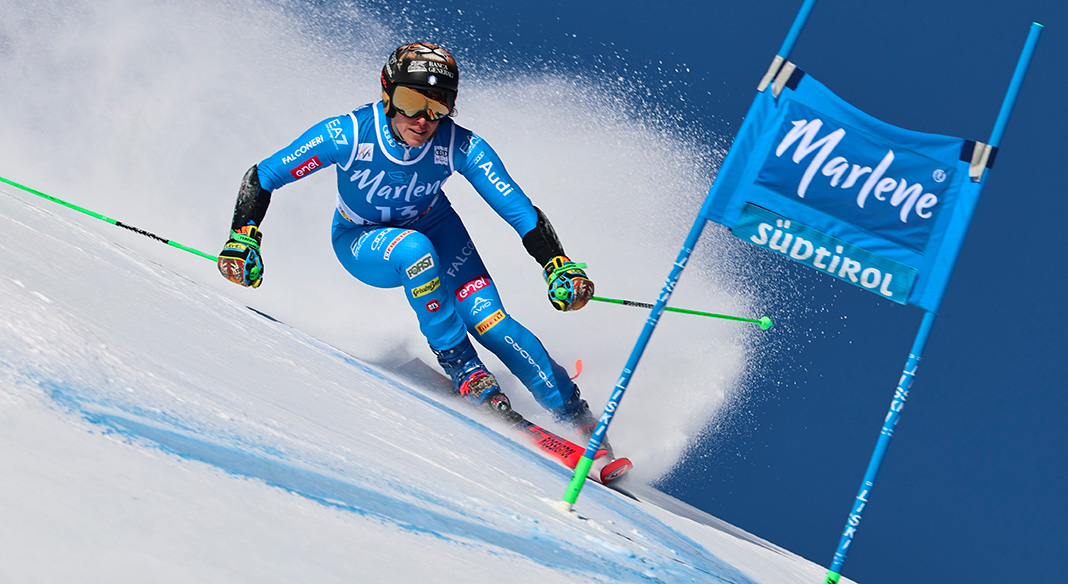
Did you know that women are more likely to get injured than men? For example, in alpine skiing, the risk of anterior cruciate ligament (ACL) injuries is about twice as high in women (British Medical Journal, 2016). The most interesting thing is that the causes are not yet entirely clear. This is because, despite women now being numerically equal to men, there is still insufficient scientific research on how their bodies function in sports. Indeed, many rules in sports medicine and exercise physiology are derived precisely from studies of the male body.
A study (Underrepresentation of women in exercise science and physiology research is associated with authorship gender - J. James et al., 2023 PubMed) sifted through nearly 1,000 scientific articles published between 1991 and 2021 in world-renowned journals such as the Journal of Applied Physiology and the British Journal of Sports Medicine. The result? In 1991, women made up only 22% of participants; by 2021, this had risen to 36%. Better, certainly, but still very far from parity.
The fact that most scientific data on sports is based on a standard model, primarily men, (Underrepresentation of women in exercise science and physiology research is associated with authorship gender - J. James et al., 2023 PubMed, means that training programs, prevention measures, and post-injury care, as well as equipment (shoes, ski bindings), have been designed with male bodies in mind. And therein lies the problem: ignoring the physiological differences between men and women is not a negligible detail. It means overlooking many factors, including the menstrual cycle.
A minor detail? Absolutely not.
For example, during the menstrual cycle, levels of estrogen and progesterone vary. These two hormones not only regulate fertility but also influence muscles, tendons, ligaments, and neuromuscular control. During certain phases of the cycle, especially around ovulation, estrogen levels increase. This hormone makes connective tissues like ligaments more elastic and less rigid. Sounds positive, right? Partially, yes. But too much elasticity also means less joint stability, especially in the knee. And in some sports, such as alpine skiing, where more stability is needed, this could increase the likelihood of injury (Knee Injuries: Female Athletes at Higher Risk. Why? - Humanitas San Pio X). This doesn't mean women are more fragile, but rather that training, prevention, and loads should be adapted to these variations, not based on male models.
And this brings us back to the central point: if science almost exclusively studies men, these variations are not incorporated into protocols. As a result, female athletes end up training, competing, and recovering according to models designed for a body that... simply isn't theirs.
While it's true that there have never been so many women at the Winter Olympics, can we truly speak of equality?